 Pond02 is a product that provides slow release oxygen to your pond. Use Pond02 during the summer months when water temperatures are high and oxygen levels are low. Low oxygen levels can be harmful to fish, so keep fish happy all summer long with Pond02. Benefits include: Improves dissolved oxygen levels Helps improve water quality Non-harmful to fish, aquatic plants, and pets Enhances aquatic plant root growth Application Rate:Inital application - 1 cup per 500 gallons. Reduce to 1/2 cup twice a month thereafter. Granular - distribute throughout entier pond for best results.
Wednesday, March 28, 2007
NEW PRODUCTS 2007 : Pond 02 Slow Release Oxygen
Pond02 is a product that provides slow release oxygen to your pond. Use Pond02 during the summer months when water temperatures are high and oxygen levels are low. Low oxygen levels can be harmful to fish, so keep fish happy all summer long with Pond02. Benefits include: Improves dissolved oxygen levels Helps improve water quality Non-harmful to fish, aquatic plants, and pets Enhances aquatic plant root growth Application Rate:Inital application - 1 cup per 500 gallons. Reduce to 1/2 cup twice a month thereafter. Granular - distribute throughout entier pond for best results.

Friday, March 23, 2007
Robyn's Pond Book
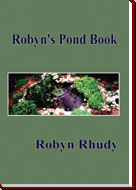
Do you like Robyn's Pond Pages and want to read them all but do not want to wait for a slow internet connection, read off a computer screen, or print countless pages? Then, you need Robyn's Pond Book! No electricity required, no irritating colors, no waiting, no banging your head on the computer screen, no blurry vision, no wasted paper!
Do you know a pond keeper for whom you need to buy a gift? Try Robyn's Pond Book! It's guaranteed that they don't have it! Whether they haven't started their first pond or are experienced, they will learn something from Robyn's Pond Book or at least enjoy my stories! People who had no interest in ponds whatsoever have told me that because of my site, they had to have a pond!
If you answered yes to any of these questions, then you want Robyn's Pond Book!
Order Robyn's Pond Book on-line at Authorhouse.com or call 1-888-280-7715 now!
Tuesday, March 20, 2007
Good Reads
 In the fine tradition of its excellent how-to guides for raising houseplants, DK here offers a practical and visually appealing manual for all who would keep fish. The author has written various natural history titles and is a consultant to the pet industry. More than 800 individual fish, invertebrate, and plant species are described.
 The book begins with a short introduction to the natural history of fish, their classification, and the history of fish keeping. The first major section covers the most popular kind of fish, those that live in fresh water. It begins with the practicalities of setting up and maintaining a tank, including descriptions of common problems and how to address them. Next is a very rich directory of fish organized by family or genus, with commonly available strains (including a few well-known rarities) discussed in terms of their size, temperament, and required conditions for culture. A brief directory of freshwater plants rounds out this section.
For those who like more of a challenge, marine fish are treated next. Following the same general structure as the freshwater fish section, Alderton divides marine fish into parts on culture and fish by family or genus, then finishes with a section on marine invertebrates. A shorter but still very useful section on the basics of keeping pond fish, again with sections on setup, fish by family or genus, and plants, finishes up the body of this volume. A glossary of terms, a handy list of Web sites, and indexes (one by common and scientific names, the other of more general terms) round things out.
This book is a fun read for fish keepers and voyeurs alike. The well-organized and authoritative content lives happily next to beautiful photographs. School and public libraries should strongly consider this volume for their reference shelves. A few circulating copies are a good bet to get heavy circulation in recreational collections at all levels. --Booklist
Tuesday, March 13, 2007
5 Tips
 One of the best things that individuals can include into their backyard is a fish pond. This will make the landscape of any garden appear more tranquil and beautiful. But the work that goes into having a fish pond does not end once the fish has been dropped into their new home. Fish pond maintenance means routinely cleaning and taking care of the fish pond!
Here are some easy to follow tips for fish pond maintenance:
1. Building a fish pond entails more work than just digging a hole in the ground, and filling it with water. The first thing individuals have to do is use a plastic lining to separate the ground from what to become the fish pond. This way the debris and soil nutrient does not get into the pond.
2. Including an assortment of plants inside the fish pond, and planting it around the edges will help manage and absorb the nutrients in the fish pond. Some water plants will also help to control the presence of algae. Not only does plants decorate the fish pond, but it also helps to combat the outburst of algae.
3. Be careful where you dig your fish pond. Where the fish pond is located can determine how much work a person has to put in to maintain a clean fish pond.
One of the problems that can occur from having a fish pond that is located under a tree is that it is hard to keep it clean of debris. This is because the leaves that have shed goes right into the fish pond. Although this might look beautiful, it is hard to maintain and keep free of pollution. Individuals would constantly have to fish out the debris that goes into the fish pond.
4. Also, digging a fish pond on the lowest ground level in the backyard is not the best idea.
This is because it will tend to get flooded when you water your lawn.
Individuals will have their hands full with taking care of the fish pond without having to worry about other sources of pollution. So right from the very beginning of construction, people should be careful where they dig their fish pond!
5. Outline the edges with rock. One should be careful when selecting the rocks that will line the edges of the pond. Some rocks when absorbed by water, give off substance that might be toxic to the aquatic life that resides inside the pond. This will prevent the soil from going into the pond when people are walking, or changing out near the fish pond.
Remember that when it comes to taking care of a fish pond, the best way to keep it clean starts with its lay out. Make sure that it is built properly.
To learn more about tips on fish pond maintenance, please visit http://www.backyard-fish-ponds-care.com/.
Article Source: http://EzineArticles.com/?expert=Tim_Lee
Wednesday, March 7, 2007
Spring Time
Almost. Instead of gauging when spring in coming by the groundhog and his dismal shadow, we should be taking a look at whether or not your fish are responding and eating food! Mine ate today, I feel spring coming! I guess the groundhog saw his shadow this year too. Coincidence I think.
How to choose Pond Fish( Koi, Goldfish, Golden Orfe )
Koi are the most spectacular ornamental pond fish to add to a garden pond. Large and beautiful, Koi carp can also be tamed to eat out of a persons hand. Koi are not suitable for very small ponds (they must have at least 200 gallons of pond water per fish) and must have adequate pond filtration. Koi can live a very long time (40+ years) if the right environment is provided!
Goldfish are the staple of garden ponds. They adapt readily to a wide range of pond conditions, are bright and colorful and breed easily, producing alot of baby fish. Goldfish are suitable for all but the smallest of barrel gardens. Many different varieties are available, but we recommend only the comet shaped ones for outdoor fish ponds. We recommend only the comet shaped Goldfish.
Orfe are sociable fish and should always be kept in schools of at least three. Orfe are fast swimmers and need a lot of oxygen. Consequently, they spend most of the time near the surface of the pond. Golden Orfe will jump out of very small ponds because they like lots of room to play and they love to catch bugs. We recommend at least a 500 gallon pond for Orfe.
All of these pond fish are cold water varieties and can remain in the pond during the winter with proper preparation, as long as the pond is deep and large enough and care is taken that it does not freeze completely.
(For more detailed - and free - Pond winterizing instructions, Click Here to download our e-book "Winterizing the Garden Pond" - and many other titles).
Wild snf game fish are not suitable for the garden pond. Some are predators and can harm other fish, others are bottom feeders and tend to stir up the bottom, keeping the water murky.
Pond fish should be fed suitable Pond Fish Food to assure healthy fish and a stable environment in the pond. Low quality Pond Food will result in the fish producing more waste and polluting the pond.
How to choose Pond Fish( Koi, Goldfish, Golden Orfe )
Koi are the most spectacular ornamental pond fish to add to a garden pond. Large and beautiful, Koi carp can also be tamed to eat out of a persons hand. Koi are not suitable for very small ponds (they must have at least 200 gallons of pond water per fish) and must have adequate pond filtration. Koi can live a very long time (40+ years) if the right environment is provided!
Goldfish are the staple of garden ponds. They adapt readily to a wide range of pond conditions, are bright and colorful and breed easily, producing alot of baby fish. Goldfish are suitable for all but the smallest of barrel gardens. Many different varieties are available, but we recommend only the comet shaped ones for outdoor fish ponds. We recommend only the comet shaped Goldfish.
Orfe are sociable fish and should always be kept in schools of at least three. Orfe are fast swimmers and need a lot of oxygen. Consequently, they spend most of the time near the surface of the pond. Golden Orfe will jump out of very small ponds because they like lots of room to play and they love to catch bugs. We recommend at least a 500 gallon pond for Orfe.
All of these pond fish are cold water varieties and can remain in the pond during the winter with proper preparation, as long as the pond is deep and large enough and care is taken that it does not freeze completely.
(For more detailed - and free - Pond winterizing instructions, Click Here to download our e-book "Winterizing the Garden Pond" - and many other titles).
Wild snf game fish are not suitable for the garden pond. Some are predators and can harm other fish, others are bottom feeders and tend to stir up the bottom, keeping the water murky.
Pond fish should be fed suitable Pond Fish Food to assure healthy fish and a stable environment in the pond. Low quality Pond Food will result in the fish producing more waste and polluting the pond.
Saturday, March 3, 2007
Algae Facts
When it comes to algae control and water clarity you have two choices in dealing with it: Artificially or Naturally.
Artificial methods include algaecides and chemicals that kill any and all life in the water, similar to filtering a swimming pool. These methods are best used in formal fountains and some indoor water features where plants and fish are not desired.
Natural methods include plants, fish, and good bacteria that work with Mother Nature, not against her. Since the majority of pond owners are interested in both plants and fish we have chosen to elaborate more on the natural ways to ensure a healthy well balanced ecosystem.
Tips & Facts On Controlling Algae Naturally
Plants: Algae is a plant, it requires nutrients and light to grow. When you add aquatic plants to your ecosystem they directly compete for the nutrients available. Add enough plants and you naturally minimize the nutrients. If your pond contains few or no plants and you are experiencing algae, adding plants should be one of the first remedies tried.
Overfeeding fish: Feed your fish less than you would like. Undigested fish food is the primary pollutant in many ponds. Your fish consume many things in the pond including algae. Excessive food increases waste and nutrients that feed the algae. Ponds overloaded with to many fish also become harder to keep in balance. During algae blooms reduce or eliminate feeding until it is under control.
Reduce sunlight penetration: Cover at least 50-60% of the surface area of your pond with plants. Bare expanses of water are much more difficult to keep in balance than ponds filled with beneficial plants.
Add bacteria: Routinely introduce good bacteria into your ecosystem. Larger doses when cooler water temperatures are present and monthly during the warmer months. Healthy colonies of bacteria play an important part in ensuring a naturally balanced ecosystem.
Circulate and filter the water: Pulling water from one end of the pond and filtering it before it returns at the opposite end will greatly improve water quality. Beneficial oxygen is added to the water as it is circulated. A filter may solve the problem if you have tried other methods unsuccessfully.
Control runoff: Excess water runoff from lawns and perimeter gardens will overload the pond with nutrients and is not good for aquatic life. A slight birm of dirt sloped away from the pond will greatly reduce runoff. Drain tile may also be used in some circumstances.
Remove debris: Decaying leaves and plant debris will produce excess nutrients in your pond. Manually remove decaying aquatic plants and their leaves. A skimmer is by far the most efficient and low maintenance way to keep your pond free of debris.
Water change: A partial water change (20-30%) every 4-6 weeks may help reduce excess nutrients in some situations.
Conclusion: There are many ways to head off and control the invasion of algae. This article should be used as a guide only. It is our intent to supply some ideas that should give you a better chance in getting rid of or stopping it before it begins although we can’t guarantee it. If more advice is needed we recommend researching the internet and talking to fellow pond keepers, who are always willing to help. No matter what you read or hear, if it works for you and your pond, it works.
Artificial methods include algaecides and chemicals that kill any and all life in the water, similar to filtering a swimming pool. These methods are best used in formal fountains and some indoor water features where plants and fish are not desired.
Natural methods include plants, fish, and good bacteria that work with Mother Nature, not against her. Since the majority of pond owners are interested in both plants and fish we have chosen to elaborate more on the natural ways to ensure a healthy well balanced ecosystem.
Tips & Facts On Controlling Algae Naturally
Plants: Algae is a plant, it requires nutrients and light to grow. When you add aquatic plants to your ecosystem they directly compete for the nutrients available. Add enough plants and you naturally minimize the nutrients. If your pond contains few or no plants and you are experiencing algae, adding plants should be one of the first remedies tried.
Overfeeding fish: Feed your fish less than you would like. Undigested fish food is the primary pollutant in many ponds. Your fish consume many things in the pond including algae. Excessive food increases waste and nutrients that feed the algae. Ponds overloaded with to many fish also become harder to keep in balance. During algae blooms reduce or eliminate feeding until it is under control.
Reduce sunlight penetration: Cover at least 50-60% of the surface area of your pond with plants. Bare expanses of water are much more difficult to keep in balance than ponds filled with beneficial plants.
Add bacteria: Routinely introduce good bacteria into your ecosystem. Larger doses when cooler water temperatures are present and monthly during the warmer months. Healthy colonies of bacteria play an important part in ensuring a naturally balanced ecosystem.
Circulate and filter the water: Pulling water from one end of the pond and filtering it before it returns at the opposite end will greatly improve water quality. Beneficial oxygen is added to the water as it is circulated. A filter may solve the problem if you have tried other methods unsuccessfully.
Control runoff: Excess water runoff from lawns and perimeter gardens will overload the pond with nutrients and is not good for aquatic life. A slight birm of dirt sloped away from the pond will greatly reduce runoff. Drain tile may also be used in some circumstances.
Remove debris: Decaying leaves and plant debris will produce excess nutrients in your pond. Manually remove decaying aquatic plants and their leaves. A skimmer is by far the most efficient and low maintenance way to keep your pond free of debris.
Water change: A partial water change (20-30%) every 4-6 weeks may help reduce excess nutrients in some situations.
Conclusion: There are many ways to head off and control the invasion of algae. This article should be used as a guide only. It is our intent to supply some ideas that should give you a better chance in getting rid of or stopping it before it begins although we can’t guarantee it. If more advice is needed we recommend researching the internet and talking to fellow pond keepers, who are always willing to help. No matter what you read or hear, if it works for you and your pond, it works.
Subscribe to:
Posts (Atom)

