Thursday, April 19, 2007

Needs new home


FOR SALE! 37 Gallon fish tank and stand in new condition! Just bought it and now I have to move and can't take it. I will take $150 or best offer. Buyer needs to pick up. It comes with: Penguin Bio Wheel Filtration System New Heater New Artificial Plants Automatic feeder +other tank furnishings and supplies You have an option to take the fish as well. The Fish include: 2 Bala Sharks (one 6inch, one 4inch long) 1 Angel Fish (large and in beautiful condition) 1 Lepord Catfish (4inches long) 1 Molly (small and red)

Wednesday, April 11, 2007

Angel Fish need home in Oahu, so do I!


Two large angel fish are looking for a new home. These are fish that need a 20+ size tank. We are asking for a small rehoming fee.

Monday, April 9, 2007

Fish Tips

A couple of weeks ago I had a problem with some fish in my pond. Two of my sarasa comets were showing signs of distress. One had a red blotch developing on its side, and another was having trouble with its bouyancy, and seemed very lethargic. Although she was able to swim and move around the pond, when she stopped she would slowly float up to the surface, and go upside down. Also she looked very bloated.I know of two very helpful websites which I immediately visited to learn what the problem was.These are www.fishdoc.co.uk and www.ponddoc.com. Both sites provide excellent advice on how to diagnose illness and disease your fish may have, and what to do about it.I have learnt a lot about the problems my fish were having, and why too. The quality of my pond water is normally very good - clear and clean, with virtually zero nitrates levels, and perfect pH balance (acidity/alkaline). Also we have quite a few baby fish hatched, so this in itself indicates that the balance of the pond is comfortable for the fish to do what comes naturally! Some tests to check the water-quality proved everything was ok and within normal ranges, so this was not the cause for my ill fish. After reading up on the FishDoc and PondDoc sites this is what I found out:Your fish are most vulnerable to parasites and disease at the start of the year, when the temperatures are not stable and high enough for your fishes immune systems to "get going". This year in particular the UK has had a slow start to the spring/summer season, with temperatures fluctuating wildly. Bright sunny, almost summer days early on, but then dropping back to almost freezing again a day or two later. This means the water temperature in the pond has been sufficient for the lower life forms to come out of hibernation (e.g. bacteria and parasites), but it has not been a consistently high enough temperature for the fish to develop their own immune systems properly.The result is that tiny critters have been able to cause problems before the fish are strong enough to defend themselves. Particularly since the fish have been staying low at the bottom of the pond during the winter where parasites can attach themselves to a fish, and wait until warmer days when they begin doing their damage!One of the things both FishDoc and PondDoc recommend is that you do not jump to conclusions when diagnosing your fishes illness. It is far better to be sure about the kind of disease before attempting to provide a cure.In the meantime they recommend that you take some initial "first aid" measures to help start your fish on the road to recovery. A salt bath is a good initial treatment for fish. It helps to kill external bacteria and parasites, and helps increase the natural mucous film coating on your fish. It is better to use something like Interpet Pond Guardian Salt which is designed for use in ponds, but you can use either sea-salt or table salt instead. Do not use salt containing anti-caking agents such as sodium ferrocyanide (yellow prussiate of soda – this can release hydrogen cyanide when exposed to sunlight).If you have never done a salt bath before here are some tips:-

The amount of salt you use in a container or holding tank does look like a lot of salt! It has to be sufficient concentration to make it effective for a short term bath of maybe 20 minutes. The page at the link above explains why you need this much, and diagrams show how the salt bath works on your fish.

Use a white container to put the fish in for its salt bath (I use a 10 litre empty fish food tub, but this may not be large enough if you have bigger fish). This will help to "light up" the fish and make it easier to inspect the general condition of its body, scales, etc while it is having the bath. Have the container filled, ready and by the pond so you can transfer the fish quickly and easily.
Have a decent size net with a good long handle. Use it with slow and gentle movements to catch the ill fish. Once caught, lower the whole net into the container and down and away from the fish, rather than just tipping the fish into the container because you run the risk of the fish struggling and falling onto the edge of the container.

The fish may float in the bath. This is to be expected, and occurs because of the concentration of the salt making it more bouyant (think how it is easier for you to float in the sea in comparison to when in a swimming pool).

After this high concentration salt bath (do not leave the fish in it too long, generally 15-20 minutes, and certainly no more than 30 minutes, depending on the strength of the fish), you should consider adding some salt as a general tonic to the main pond. This will help all your fish build up their natural slime defence on their bodies, and help to weaken parasites.
Follow the instructions carefully for any other disease treatment that may need to be added to the pond once you diagnose what the problem is. Often parasite and disease treatments contain formaldehyde so you must not overdose the pond.

If you add salt to the pond, more than say 1% solution, you should consider that some species of plants cannot tolerate salt and may be best removed from the pond and put into another container for a couple of weeks.

After 1 or 2 weeks, perform some water change topups in the pond to weaken the salt solution. This will probably occur naturally with regular topups and rainfall.

Tuesday, April 3, 2007

My Pet Fish Soap

"My Pet Fish" Soap looks like the bag that you carry home from the pet store, but don’t be fooled…these plastic fish are not swimming in water, they are embedded in clear, vegetable based glycerin soap shaped like "water in a bag". A great party favor. Fun for kids from 1 to 100. Comes in assorted colors; let us choose the color. Soap has no scent; measures about 3 1/2"H x 3" at widest; 5 1/2"My Pet Fish Soap from top to bottom of bag.

Wednesday, March 28, 2007

NEW PRODUCTS 2007 : Pond 02 Slow Release Oxygen

Pond02 is a product that provides slow release oxygen to your pond. Use Pond02 during the summer months when water temperatures are high and oxygen levels are low. Low oxygen levels can be harmful to fish, so keep fish happy all summer long with Pond02. Benefits include: Improves dissolved oxygen levels Helps improve water quality Non-harmful to fish, aquatic plants, and pets Enhances aquatic plant root growth Application Rate:Inital application - 1 cup per 500 gallons. Reduce to 1/2 cup twice a month thereafter. Granular - distribute throughout entier pond for best results.
Friday, March 23, 2007

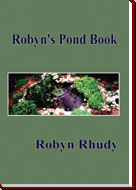
Robyn's Pond Book


Do you like Robyn's Pond Pages and want to read them all but do not want to wait for a slow internet connection, read off a computer screen, or print countless pages? Then, you need Robyn's Pond Book! No electricity required, no irritating colors, no waiting, no banging your head on the computer screen, no blurry vision, no wasted paper!
Do you know a pond keeper for whom you need to buy a gift? Try Robyn's Pond Book! It's guaranteed that they don't have it! Whether they haven't started their first pond or are experienced, they will learn something from Robyn's Pond Book or at least enjoy my stories! People who had no interest in ponds whatsoever have told me that because of my site, they had to have a pond!
If you answered yes to any of these questions, then you want Robyn's Pond Book!
Order Robyn's Pond Book on-line at Authorhouse.com or call 1-888-280-7715 now!

Tuesday, March 20, 2007

Good Reads

In the fine tradition of its excellent how-to guides for raising houseplants, DK here offers a practical and visually appealing manual for all who would keep fish. The author has written various natural history titles and is a consultant to the pet industry. More than 800 individual fish, invertebrate, and plant species are described.


The book begins with a short introduction to the natural history of fish, their classification, and the history of fish keeping. The first major section covers the most popular kind of fish, those that live in fresh water. It begins with the practicalities of setting up and maintaining a tank, including descriptions of common problems and how to address them. Next is a very rich directory of fish organized by family or genus, with commonly available strains (including a few well-known rarities) discussed in terms of their size, temperament, and required conditions for culture. A brief directory of freshwater plants rounds out this section.

For those who like more of a challenge, marine fish are treated next. Following the same general structure as the freshwater fish section, Alderton divides marine fish into parts on culture and fish by family or genus, then finishes with a section on marine invertebrates. A shorter but still very useful section on the basics of keeping pond fish, again with sections on setup, fish by family or genus, and plants, finishes up the body of this volume. A glossary of terms, a handy list of Web sites, and indexes (one by common and scientific names, the other of more general terms) round things out.


This book is a fun read for fish keepers and voyeurs alike. The well-organized and authoritative content lives happily next to beautiful photographs. School and public libraries should strongly consider this volume for their reference shelves. A few circulating copies are a good bet to get heavy circulation in recreational collections at all levels. --Booklist

Tuesday, March 13, 2007

5 Tips

One of the best things that individuals can include into their backyard is a fish pond. This will make the landscape of any garden appear more tranquil and beautiful. But the work that goes into having a fish pond does not end once the fish has been dropped into their new home. Fish pond maintenance means routinely cleaning and taking care of the fish pond!

Here are some easy to follow tips for fish pond maintenance:
1. Building a fish pond entails more work than just digging a hole in the ground, and filling it with water. The first thing individuals have to do is use a plastic lining to separate the ground from what to become the fish pond. This way the debris and soil nutrient does not get into the pond.

2. Including an assortment of plants inside the fish pond, and planting it around the edges will help manage and absorb the nutrients in the fish pond. Some water plants will also help to control the presence of algae. Not only does plants decorate the fish pond, but it also helps to combat the outburst of algae.

3. Be careful where you dig your fish pond. Where the fish pond is located can determine how much work a person has to put in to maintain a clean fish pond.
One of the problems that can occur from having a fish pond that is located under a tree is that it is hard to keep it clean of debris. This is because the leaves that have shed goes right into the fish pond. Although this might look beautiful, it is hard to maintain and keep free of pollution. Individuals would constantly have to fish out the debris that goes into the fish pond.

4. Also, digging a fish pond on the lowest ground level in the backyard is not the best idea.

This is because it will tend to get flooded when you water your lawn.
Individuals will have their hands full with taking care of the fish pond without having to worry about other sources of pollution. So right from the very beginning of construction, people should be careful where they dig their fish pond!

5. Outline the edges with rock. One should be careful when selecting the rocks that will line the edges of the pond. Some rocks when absorbed by water, give off substance that might be toxic to the aquatic life that resides inside the pond. This will prevent the soil from going into the pond when people are walking, or changing out near the fish pond.
Remember that when it comes to taking care of a fish pond, the best way to keep it clean starts with its lay out. Make sure that it is built properly.

To learn more about tips on fish pond maintenance, please visit http://www.backyard-fish-ponds-care.com/.
Article Source: http://EzineArticles.com/?expert=Tim_Lee

Wednesday, March 7, 2007

Spring Time

Almost. Instead of gauging when spring in coming by the groundhog and his dismal shadow, we should be taking a look at whether or not your fish are responding and eating food! Mine ate today, I feel spring coming! I guess the groundhog saw his shadow this year too. Coincidence I think.

How to choose Pond Fish( Koi, Goldfish, Golden Orfe )
Koi are the most spectacular ornamental pond fish to add to a garden pond. Large and beautiful, Koi carp can also be tamed to eat out of a persons hand. Koi are not suitable for very small ponds (they must have at least 200 gallons of pond water per fish) and must have adequate pond filtration.
Koi can live a very long time (40+ years) if the right environment is provided!
Goldfish are the staple of garden ponds. They adapt readily to a wide range of pond conditions, are bright and colorful and breed easily, producing alot of baby fish.
Goldfish are suitable for all but the smallest of barrel gardens. Many different varieties are available, but we recommend only the comet shaped ones for outdoor fish ponds. We recommend only the comet shaped Goldfish.

Orfe are sociable fish and should always be kept in schools of at least three. Orfe are fast swimmers and need a lot of oxygen. Consequently, they spend most of the time near the surface of the pond. Golden Orfe will jump out of very small ponds because they like lots of room to play and they love to catch bugs. We recommend at least a 500 gallon pond for Orfe.
All of these pond fish are cold water varieties and can remain in the pond during the winter with proper preparation, as long as the pond is deep and large enough and care is taken that it does not freeze completely.

(For more detailed - and free - Pond winterizing instructions, Click Here to download our e-book "Winterizing the Garden Pond" - and many other titles).

Wild snf game fish are not suitable for the garden pond. Some are predators and can harm other fish, others are bottom feeders and tend to stir up the bottom, keeping the water murky.
Pond fish should be fed suitable Pond Fish Food to assure healthy fish and a stable environment in the pond. Low quality Pond Food will result in the fish producing more waste and polluting the pond.

Saturday, March 3, 2007

Algae Facts

When it comes to algae control and water clarity you have two choices in dealing with it: Artificially or Naturally.

Artificial methods include algaecides and chemicals that kill any and all life in the water, similar to filtering a swimming pool. These methods are best used in formal fountains and some indoor water features where plants and fish are not desired.

Natural methods include plants, fish, and good bacteria that work with Mother Nature, not against her. Since the majority of pond owners are interested in both plants and fish we have chosen to elaborate more on the natural ways to ensure a healthy well balanced ecosystem.

Tips & Facts On Controlling Algae Naturally
Plants: Algae is a plant, it requires nutrients and light to grow. When you add aquatic plants to your ecosystem they directly compete for the nutrients available. Add enough plants and you naturally minimize the nutrients. If your pond contains few or no plants and you are experiencing algae, adding plants should be one of the first remedies tried.

Overfeeding fish: Feed your fish less than you would like. Undigested fish food is the primary pollutant in many ponds. Your fish consume many things in the pond including algae. Excessive food increases waste and nutrients that feed the algae. Ponds overloaded with to many fish also become harder to keep in balance. During algae blooms reduce or eliminate feeding until it is under control.

Reduce sunlight penetration: Cover at least 50-60% of the surface area of your pond with plants. Bare expanses of water are much more difficult to keep in balance than ponds filled with beneficial plants.

Add bacteria: Routinely introduce good bacteria into your ecosystem. Larger doses when cooler water temperatures are present and monthly during the warmer months. Healthy colonies of bacteria play an important part in ensuring a naturally balanced ecosystem.

Circulate and filter the water: Pulling water from one end of the pond and filtering it before it returns at the opposite end will greatly improve water quality. Beneficial oxygen is added to the water as it is circulated. A filter may solve the problem if you have tried other methods unsuccessfully.

Control runoff: Excess water runoff from lawns and perimeter gardens will overload the pond with nutrients and is not good for aquatic life. A slight birm of dirt sloped away from the pond will greatly reduce runoff. Drain tile may also be used in some circumstances.

Remove debris: Decaying leaves and plant debris will produce excess nutrients in your pond. Manually remove decaying aquatic plants and their leaves. A skimmer is by far the most efficient and low maintenance way to keep your pond free of debris.

Water change: A partial water change (20-30%) every 4-6 weeks may help reduce excess nutrients in some situations.

Conclusion: There are many ways to head off and control the invasion of algae. This article should be used as a guide only. It is our intent to supply some ideas that should give you a better chance in getting rid of or stopping it before it begins although we can’t guarantee it. If more advice is needed we recommend researching the internet and talking to fellow pond keepers, who are always willing to help. No matter what you read or hear, if it works for you and your pond, it works.

Monday, February 26, 2007

How to set up an Outdoor Pond

The pleasure you'll get from your pond in the long run makes it worth the hassle of installing it.
Instructions
STEP 1: Lay out a bright-colored string on the ground in the outline of your proposed pond. If you're using a preformed pond, lay the liner out and outline it with string.
STEP 2: Look at it from your windows, patio and yard to be sure you like the location.
STEP 3: Use spray paint to mark the entire outline of your pond when you're satisfied with the shape and location.
STEP 4: Start about 3 inches out from the paint marks with a shovel and begin removing the sod and topsoil around the perimeter of the pond.
STEP 5: Lay a 2-by-4-inch board across the width of one end of the pond.
STEP 6: Set a carpenter's level on the board and make sure that the edge of the pond is level. Add topsoil to the edge if it's not.
STEP 7: Continue this process until you are certain that the entire pond edge is perfectly level. If it isn't, the liner will show where it's higher than the rest and could leak water where it's lower.
STEP 8: Start digging at the center of the pond. The walls should slope at about a 20 to 30 degree angle. Dig 2 inches deeper than the pond will be.
STEP 9: When the hole is complete, check for things poking out of the ground that might tear the liner, such as rocks or roots. Remove them if you find any.
STEP 10: Lay 2 inches of sand evenly across the bottom for drainage. It packs well if you get it wet.
STEP 11: Roll the liner out in the sun to heat it up. This will make it more flexible and easier to work with.
STEP 12: Lay the liner in the correct position in the pond, being careful not to move the sand too much.
STEP 13: Fill the pond with water.
STEP 14: Cut away the extra liner in places where it sticks up above ground level. Keep these pieces in case you need to patch the liner in the future.
STEP 15: Dechlorinate the water before you add fish and plants.
Tips & Warnings
Rooted plants typically are put into the pond in pots with a layer of gravel on top of the potting soil.

Rinse all of your plants before putting them in the pond. Soak them in a solution of 1 part bleach to 20 parts water. Dip the plant for about 2 minutes and rinse it immediately in cool running water. Next dip it in water treated with a dechlorinator to neutralize any remaining bleach.
The pond liner is by far the biggest expense, and the materials vary widely. Fish-grade PVC lasts between 7 and 15 years; fish-grade rubber will last twice that long. A preformed fiberglass pond will last about 50 years, while concrete could last as long as the house, though putting it in is a lot more work.

Wednesday, February 21, 2007

The Pond Cocktail

So, the fishies are so happy. It's approx. 50 degrees outside, but there's a chance of another blizzard on Saturday. Which doesn't make me happy since we're having a dinner party this weekend. Anyway, I've found the following make for a very happy outdoor pond--mine is approx 150gallons.
1T baking soda
1 drop Clear Pond solution
1 drop Algae remover
1T love, haha!

Friday, February 16, 2007

Fishsticks

The sacramental seven are safe under another sheet of ice. I guess it's appropriate, it's mid-February, record snow fall this year and we're going skiing tomorrow. It's like their little underwater wonderland.

Monday, February 12, 2007

Oh warm, happy days!

The sacramental seven (the hardy fish who have managed to hang on under my watchful eye), who must be touched by the firmaments since they've made it under a novice's care, received some yummy new pond water this Saturday and a nice dash of dechlorinator for good measure. They're looking fat and happy, but still a little uninterested in eating. They're loving the leaves at the bottom of the pond, I'm wondering if this Spring is going to make me into a Grandma and I'll have a million little goldfish swimming around.

Thursday, February 8, 2007

Habitattitude

These fish were found in Rock Pond on the University of Minnesota Duluth Campus. Goldfish can cause many undesirable changes to the environment when released from aquariums.

It's happening across the country on University campuses. Drunk little freshman, has to be a freshman, are throwing the prizes they got from their highschool prom into the lagoons and lakes on their university campuses. DUMB. Ever heard of Habitattidue freshman?
Go on, try to say it, Habitattitude. Campaign partners hope this new word will become common among aquarium owners and water gardeners. Habitattitude™ is the name for a national public campaign launched September 23 in Las Vegas, NV. The campaign is designed to help aquarium and water garden owners become part of the solution in preventing the release of aquatic fish and plants. The campaign's logo and "don't release" message will soon appear on fish bags, new aquariums, brochures, and ads in hobbyist magazines. This is due to a cooperative effort among the pet and water garden industries, academia, and the federal government.

When it began

It all started with an innocent trip to WalMart (ok, I know WalMart is evil) and the purchase of a fish. One fish. One fish to put into our house's little water feature/pond in the front yard. $2k and 18 fish later...these tranquil fish have my husband and me stressed out daily about their well-being in this colder then cold Colorado winter.

We purchased a livestock water-tank heater and it's been doing the trick for our 150 gallon pond, I can't believe it. With temperatures dipping into -0 range every night, these little fish are really flexing their muscles. Maybe I'm not supposed to be finding tranquility, but inspiration from these little guys.

Freerange Fish